







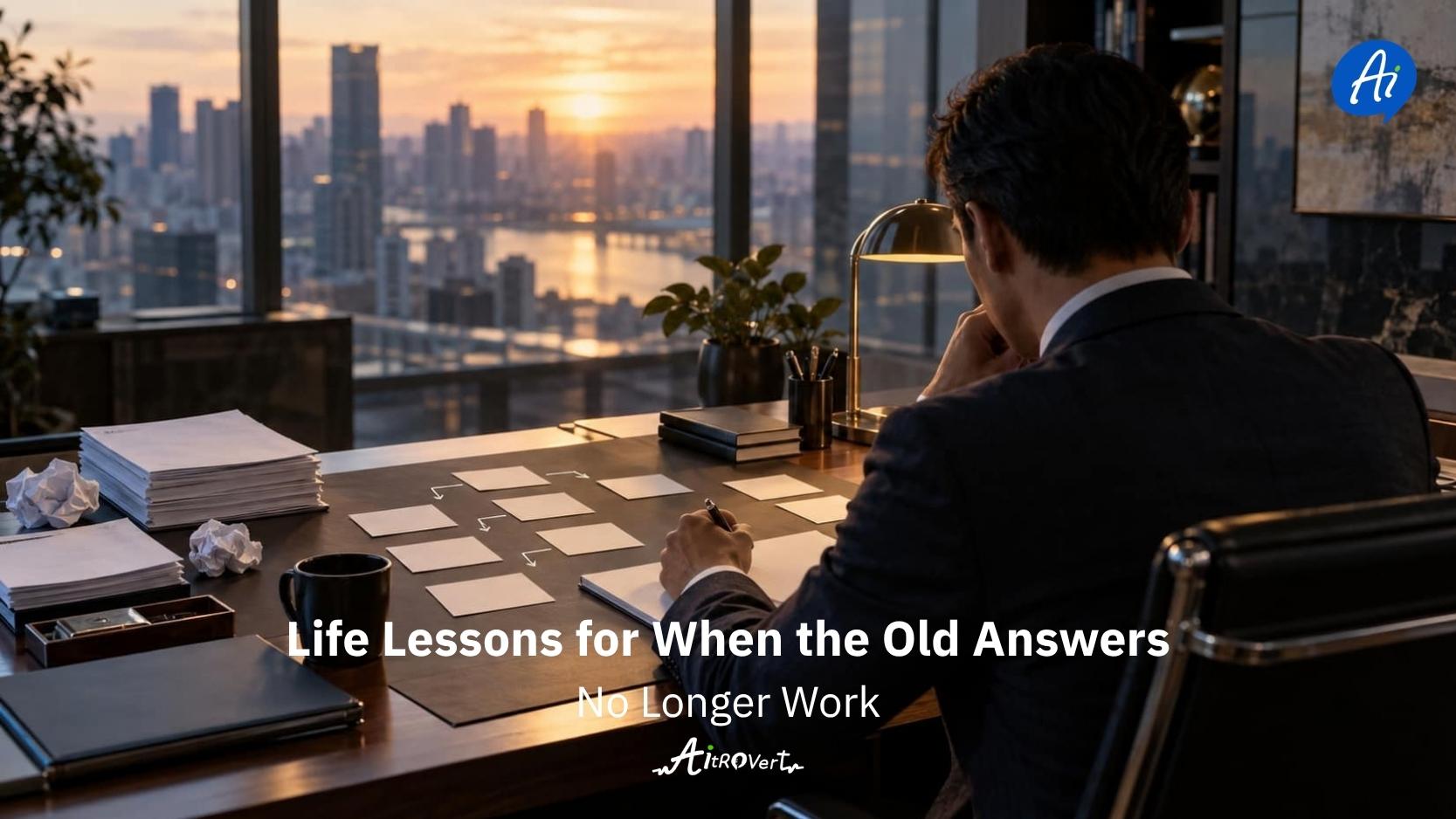

At some point, a method that used to work stops producing the same result. Familiar work becomes harder, a relationship changes, or a goal we once wanted no longer fits. That does not mean every earlier decision was wrong. It may mean the context has changed and our answer needs to change with it.
Difficult experiences do not automatically turn into life lessons. We give them value by examining what actually happened, where our choices mattered, and how we will act differently when a similar moment comes again.
Failure Does Not Teach Us Automatically

When something goes wrong, it is tempting to promise that we will “be more careful next time.” The promise is too vague to change behaviour. Reconstruct the sequence instead: what were we trying to achieve, what information did we have, why did we choose that course, and where did the result depart from our expectation?
Separate observable facts from interpretations. “The work was delivered three days late” can be checked. “I am not capable” is a judgment about a person. Treating the two as equivalent makes it harder to fix what actually happened.
Look for the assumption that did not hold. Perhaps we believed everyone understood their responsibilities, that there was enough time, or that silence meant agreement. Once the assumption is visible, it can become a question or a checkpoint in the next project.
Reflection is not always an exercise in assigning blame. Some outcomes involve factors beyond our control. We can still change how we prepare, communicate, or respond. A useful lesson ends with a specific adjustment, rather than another round of regret.
Practical Takeaways
- Separate facts from emotions
- Identify the assumption that proved false
- Define what you will do differently next time
Do Not Let One Outcome Define Your Worth

A disappointing result can shake our confidence, especially when we invested substantial effort. But one outcome tells us only that a particular approach did not work under particular conditions. It does not establish the worth or ability of an entire person.
Replace “I am a failure” with “What failed in this decision?” The second question lets us examine the information, timing, method, and coordination involved without turning a critique of the work into an attack on identity.
Ask people who saw the situation for specific feedback. Which part did not meet the need? If we started again, what should change first? Comforting praise and broad criticism can both leave us without the information needed to act.
Then separate what we control, what we can influence, and what lies outside our reach. We cannot own every shift in the market, another person’s view, or the timing of events. We can own how we respond. Self-respect and accountability for a mistake can coexist.
Practical Takeaways
- Critique the decision, not your identity
- Ask for feedback from people who saw the situation
- Separate controllable factors from external ones
Courage Does Not Require Fear to Disappear

Fear is not proof that we should wait. Sometimes it signals that an important choice carries a risk worth examining. Name the fear precisely: losing money, wasting time, facing rejection, or harming someone else. Each calls for a different response.
Once the risk is clear, make the first step small enough to learn from: share a proposal with a limited group, run one trial, or reserve time for a new project without abandoning existing commitments. A bounded step makes the fear easier to work with.
Before starting, set limits for money, time, and effects on other people. Schedule a review date as well. Without one, we may quit after the first obstacle or continue because we cannot bear to walk away from what we have already invested.
Some fears deserve closer attention, especially where health, safety, or a long-term obligation is involved. Courage does not require ignoring those signals. It means choosing an action whose consequences we can responsibly handle.
Practical Takeaways
- Start with a pilot version
- Set an acceptable downside
- Schedule the review before taking action
Turn Lessons into Decision Principles

A lesson kept only in memory is easy to forget under pressure. Write a short rule that can be used at the moment of choice: “When this situation arises, what will I check before deciding?” It should be specific enough to change an action.
If we once accepted more work than we could deliver, the lesson might not be “work harder.” A more useful rule is to check capacity, actual time required, and what would need to be delayed before saying yes to another assignment.
Do not turn a single experience into a permanent law. Note the conditions under which the lesson emerged and what might be different next time. A method that failed in one team could work in another if the roles, resources, or goals change.
Review your decision principles when new information arrives or a result challenges an old belief. Growth is not measured by having a final answer for every situation. It shows in asking better questions and making choices that fit the life and context we have now.
Practical Takeaways
- Write down what the situation taught you
- Convert the lesson into a pre-decision question
- Review the principle when the context changes
If one experience still occupies your thoughts, write three lines: what happened, what you believed at the time, and what you will check or do differently next time. We cannot change the past, but we can change how it informs our next decision.
“A valuable lesson does not guarantee that we will never fail again. It helps us notice sooner when we are heading in the wrong direction.”
Follow Ai Aiyaphat Wankawisant:
 อัยย์ อัยพัชรAi Aiyaphat